

Armed Conflict & Environmental Health

The Armed Conflict & Environmental Health Special Interest Group (SIG) brings together researchers, practitioners, and partners working on the environmental and health impacts of conflict, occupation, and systematic insecurity.
The group focuses on civilian exposures, ecosystem damage, and environmental justice, recognizing that environmental degradation is both a driver and consequence of conflict.
Armed Conflict & Environmental Health SIG
The Special Interest Group (SIG) on Armed Conflict & Environmental Health addresses how armed conflict, occupation, and chronic insecurity disrupt environmental systems, increase toxic exposures, and deepen health inequities. The focus extends beyond battlefield casualties to the long-term environmental health footprint of conflict.
Leadership:
Chair: Manolis Kogevinas
Co-Chair: Marianthi-Anna Kioumourtzoglou
Point of Contact: aceh@iseepi.org
Definition & Scope of Conflict
- Includes organized violence, occupation, systemic insecurity, and post-conflict conditions.
- Covers acute, protracted, and recovery phases.
- Focuses on civilian impacts, infrastructure failure, environmental degradation, and cumulative exposures.
- Alignes with principles of equity and environmental justice.
Why This Framing Matters
- Highlights the environmental drivers and consequences of conflict.
- Broadens inquiry beyond traditional conflict definitions (e.g., based on battle deaths).
- Emphasizes exposure pathways, ecosystem collapse, and infrastructure disruption that affect civilian health.
Upcoming Webinars/Events
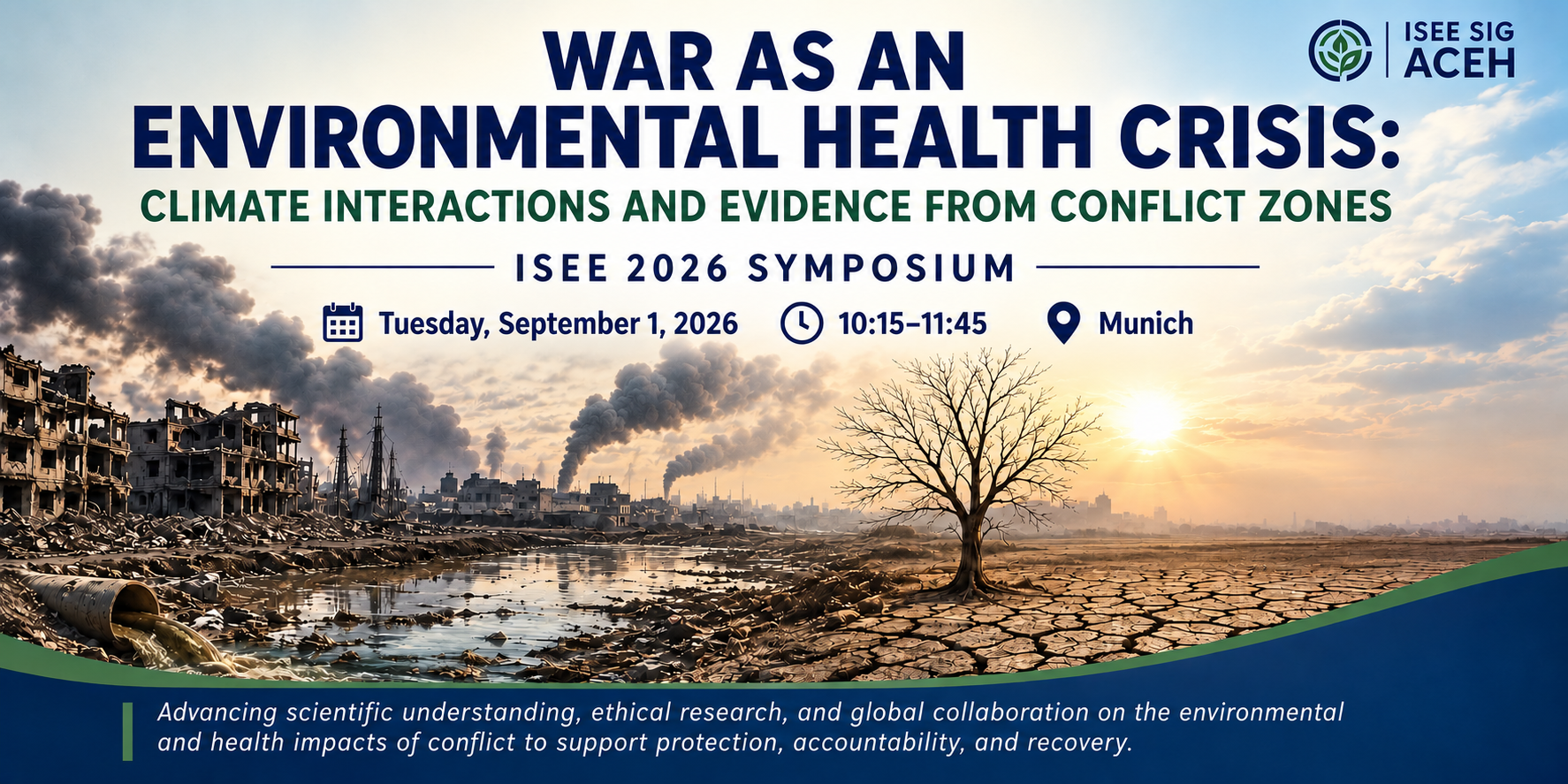
ISEE 2026 Symposium
War as an Environmental Health Crisis: Climate Interactions and Evidence from Conflict Zones
The Armed Conflict & Environmental Health Special Interest Group (SIG) is pleased to announce the symposium “War as an Environmental Health Crisis: Climate Interactions and Evidence from Conflict Zones” at the ISEE 2026 Annual Conference – "Understanding and Responding to Global and Local Challenges: Environmental Epidemiology in a Changing World" – Munich, Germany, August 30–September 2, 2026.
Date: Tuesday, September 1, 2026
Time: 10:15–11:45
Location: Mars
Symposium Speakers
- Manolis Kogevinas, ISGlobal, Barcelona, Spain
Armed Conflict as an Environmental Health Determinant
- Marianthi-Anna Kioumourtzoglou, Brown University, Providence, USA
Ecologies of Militarism: Extraction, Contamination, Health
- Barry Levy & Manolis Kogevinas, Tufts University, Boston, USA; ISGlobal, Barcelona, Spain
Environmental Health in an Active War Zone: Evidence from Ukraine
- Paul Musa Obadia & Benoit Nemery, Institut Supérieur des Techniques Médicales de Lubumbashi, Lubumbashi, Democratic Republic of the Congo; KU Leuven, Leuven, Belgium
Conflict and Violence Associated with Mining Strategic Minerals: The Case of DR Congo
- Amira Aker, Boston University, Boston, USA
Protracted Conflict and Environmental Injustice: Evidence from Palestine
- Wael Al-Delaimy, University of California San Diego, San Diego, USA
Studying Environmental Health in Conflict Settings: Methods, Ethics, and Responsibilities
Moderator/Chair: Marianthi-Anna Kioumourtzoglou, Brown University, USA
The session reflects the SIG's broader mission to advance scientific understanding, ethical research, and global collaboration on the environmental and health impacts of conflict, while supporting evidence-based approaches to protection, accountability, and recovery.
View the ISEE 2026 Conference Program: https://www.isee26.org/program/ and search War as an Environmental Health Crisis: Climate Interactions and Evidence from Conflict Zones.
Past Events

- Environmental Health Consequences of Armed Conflict in Palestine: June 17, 2:00 PM EDT (find time in your location here)
- Speaker & Moderator: Dr. Samer Abuzerr, University College of Science and Technology Khan Younis-Palestine, Dr. Mazin Qumsiyeh, Institute for Biodiversity & Sustainability Bethelhem Universit - Palenstine, Dr. Amira Aker, School of Public Health, Boston University - USA
- Speaker & Moderator: Dr. Samer Abuzerr, University College of Science and Technology Khan Younis-Palestine, Dr. Mazin Qumsiyeh, Institute for Biodiversity & Sustainability Bethelhem Universit - Palenstine, Dr. Amira Aker, School of Public Health, Boston University - USA
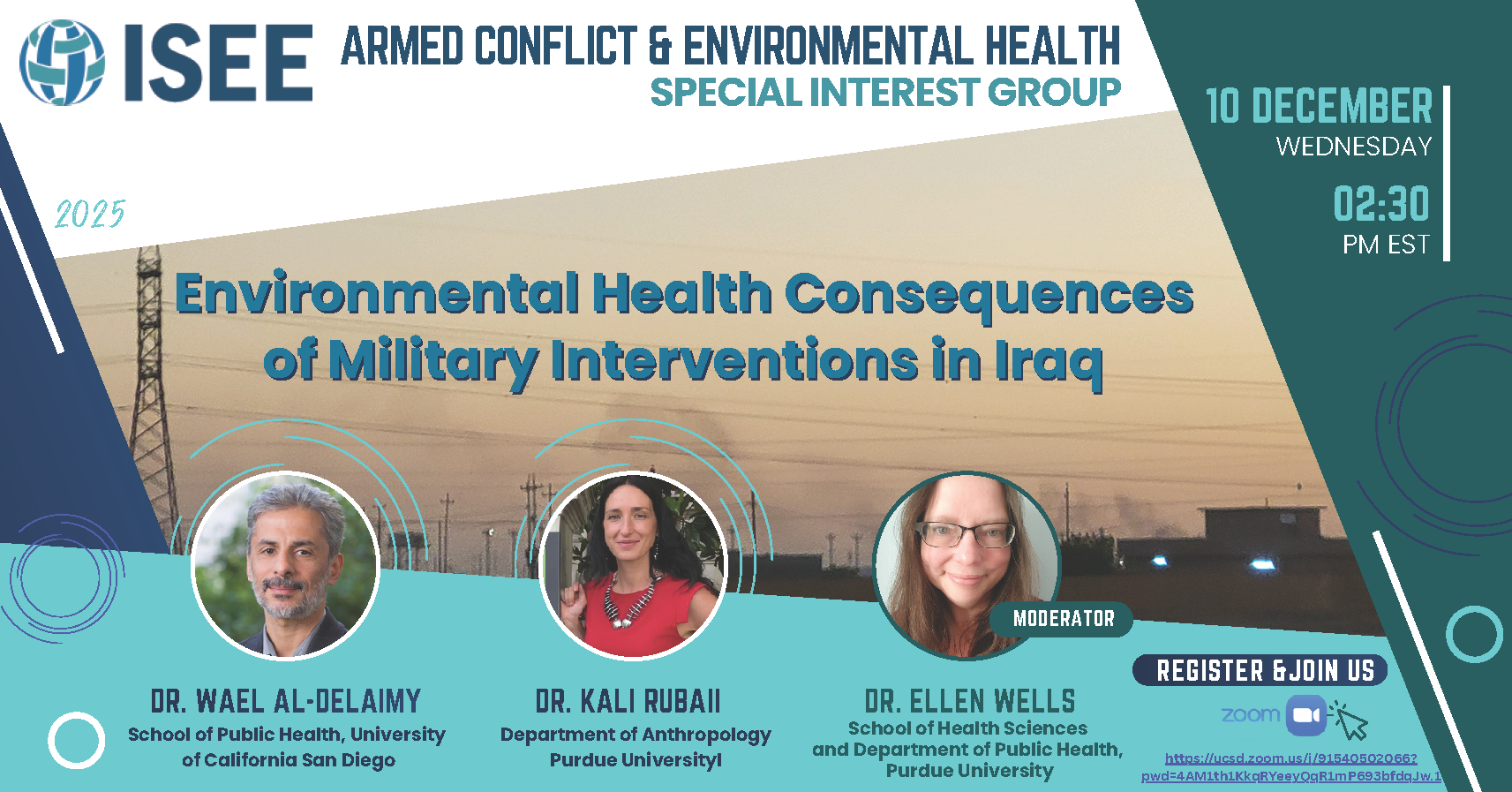
- Environmental Health Consequences of Military Interventions in Iraq: December 10, 2025, 2:30 PM EST (find time in your location here)
- Speakers & Moderator: Dr. Wael Al-Delaimy, University of California, San Diego and Dr. Kali Rubaii, Purdue University & Dr. Ellen Wells, Purdue University
- Speakers & Moderator: Dr. Wael Al-Delaimy, University of California, San Diego and Dr. Kali Rubaii, Purdue University & Dr. Ellen Wells, Purdue University
SIG Publications
Manolis Kogevinas, Marianthi-Anna Kioumourtzoglou, Amira Aker, Anass Houdou, Stephanie Grady, Aziza Menouni, Youssef Oulhote, Beate Ritz, Ellen M Wells and Wael Al-Delaimy (2025). Why Scientists Must Engage: Environmental Health in Times of Armed Conflict. International Journal of Public Health. https://www.ssph-journal.org/journals/international-journal-of-public-health/articles/10.3389/ijph.2025.1609353/abstract
Get Involved
While formal participation in the SIG requires ISEE membership, we also welcome interest from external collaborators who work in conflict-affected regions, conduct relevant research, or have access to meaningful data or partnerships.
- The SIG focuses on conflict-exposed regions where environmental and health data may be available, including Gaza, Ukraine, Iraq, the Democratic Republic of Congo, and potentially Syria, Pakistan, and India, and other armed conflict-afflicted areas.
If you are an ISEE member and would like to join this initiative, please complete this form: https://forms.gle/zbsL2inETynSbhZg9
If you are not an ISEE member but are interested in becoming a collaborator and would like to stay connected or express interest in future engagement with the SIG, please complete this form: https://forms.gle/ivD1rgVdi75Su4NK8